Spectrum will be a place to live, learn and belong in Nissewaard: built to be low in sensory load, with support that moves with you — from constant to barely there. Living starts at eighteen; taking part in the programme can start at around fourteen, so that becoming independent is a route rather than a leap. For people from Nissewaard, Voorne aan Zee, the Hoeksche Waard and Goeree-Overflakkee.
Spectrum does not exist yet. There is no building and there are no places. What does exist: a fully costed plan for thirty-two studios, a smaller version for if the financing takes time, and a growing group of people taking part. Do sign up now — then we know how large the demand is, and that is exactly what we need in order to build it.
We went through every form of supported housing in the four municipalities of the Zuid-Hollandse Delta: with providers, in municipal records and in the local press. This is what came out.
That is how many places exist in housing that is explicitly aimed at autistic people — a care farm in Ooltgensplaat, on the far side of the Haringvliet. Beyond that, nothing.
That is how many are waiting at De Hofstee in Spijkenisse — after it was expanded from 8 to 20 places in 2025.
An estimated 100 to 135 autistic adults in the region need housing with support. Spectrum is building thirty-two places.
The first two figures were counted. The third is an estimate, derived from national prevalence data from Statistics Netherlands (CBS) — the business plan sets out exactly which assumptions sit underneath it.
Not an institution and not a block of flats, but a community where the sensory load is low enough to recover in — and where support shrinks as you grow. The five building blocks below apply to everyone who takes part; four of them are open from secondary school onwards.
Designed to be low in sensory load: sound insulation, plenty of daylight, calm colours and materials. Your own front door, your own thermostat, and a doorbell you can switch off.
Four levels, from someone nearby day and night to one conversation a week. You can move in either direction without losing your home.
Buddies, themed evenings, a workshop and a neighbourhood café. Joining in is welcome, never required — and you never have to explain why you need to step away.
A practice room with VR to rehearse social situations without an audience, a planning app that makes the day predictable, and a platform for the whole region.
Four steps from day activities to paid work, with a job coach who stays with you and employers on Voorne-Putten who take part.
Someone who rehearses a job interview in the practice room does it with a buddy from the community, to find work through that same network — and then comes home to a place quiet enough to recover. That combination is the innovation.
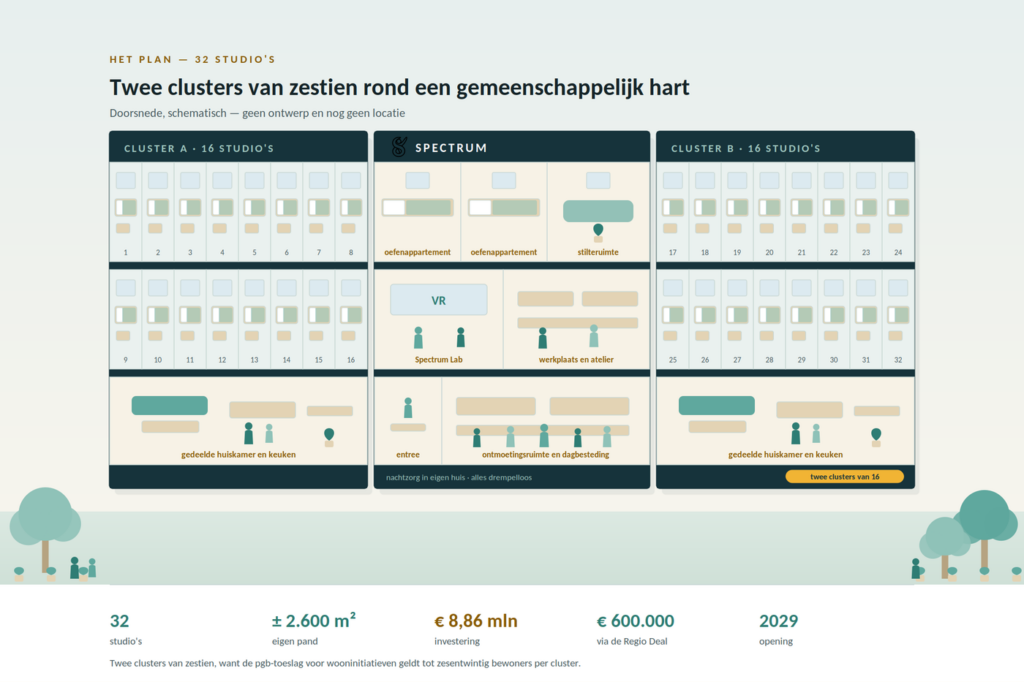
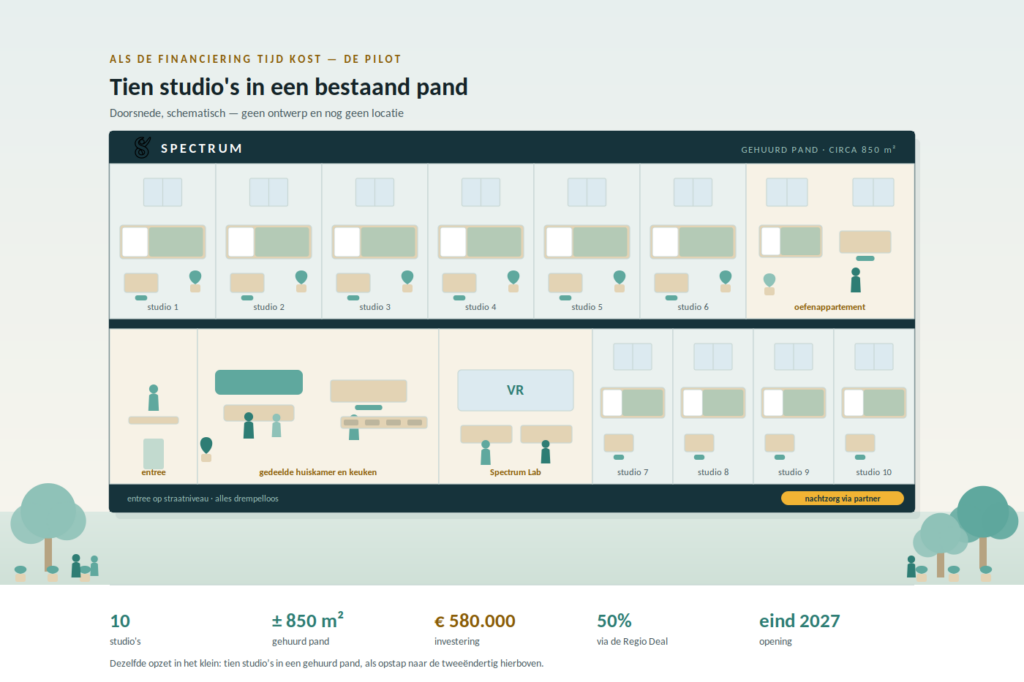
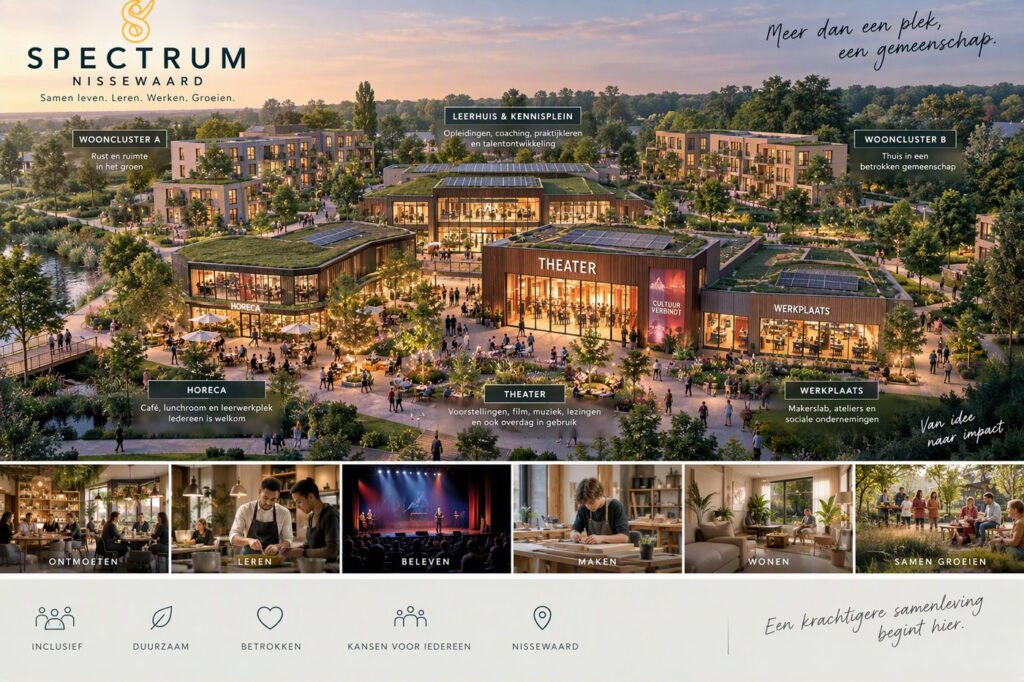
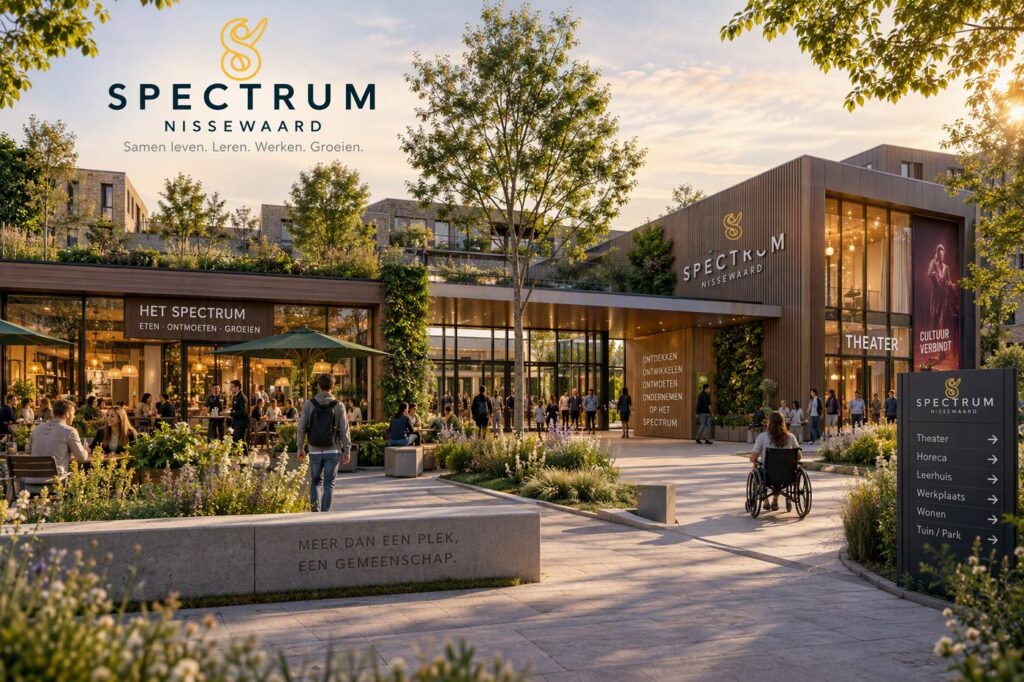
The first drawing is the plan: thirty-two studios in two clusters. The second is the same set-up at a smaller scale, for if the financing takes longer. The two images below them show where it could grow from there.
The first two drawings are schematic: they show how the plan is organised, not how it will look. The two images below them are artist impressions of a wider ambition — with a theatre, a café and a learning house. That is a later phase and a different budget. For all of it: there is no site yet, no design and no permit.
Four steps. If the financing is not ready in time, we start with ten studios in a rented building — the same model, smaller, and then on to the rest.
The business plan has been worked through. We are setting up the foundation and talking to the municipality, the care administration office and existing care providers.
Acquire an existing building of roughly 2,600 m², submit the applications and start the crowdfunding. After that the permit and the final design.
Transformation into two clusters of sixteen studios. At the same time we build the team and arrange the care licence.
The doors open, cluster by cluster. After that we measure, together with a university of applied sciences, whether the model does what we promise.
Everything here comes from the business plan of September 2026 and the financial model behind it. The full plan, including sources and assumptions, is available on request.
That is not a figure of speech: municipalities and funders literally ask us for numbers. Signing up commits you to nothing and there is no intake procedure.